Data Warning - False Official Statistics - Easy Solutions
Here you will find copies of correspondence addressing the integrity of population estimates and projections used for public policy.

From Misleading The Public To Determining Who Is 'Essential'
May 3, 2023
Correction: During the testimony, I meant to say 'Infectious Fatality Rates' not 'Case Fatality Rates'.
How the authors of the British Columbia Center of Disease Control (BC CDC) Situation Reports regarding the state of emergency declared on March 18, 2020, misrepresented the counts of Covid-19 deaths.
Do charlatans / fraudsters have the right to determine who is and who isn't 'essential'.
Summary of Review of BC Center of Disease Control (BC CDC) State of Emergency Situation Reports started on March 23, 2020 to December 18, 2020.
April 27, 2023
An effort was made by people in government positions to mislead other British Columbians.
Cover letter to National Citizens' Inquiry
BC: Canada's most corrupt province? History of a lack of integrity.
Return to Top
December 1, 2022
The problem with either the College of Physicians and Surgeons or the Minister of Health imposing injection compliance, is that either can base their decision on false and or misleading information. In any case, analytic products used to guide public policy must be open to external review, verifiable and replicable.
Letter to Adam Walker, MLA for Parksville-Qualicum, BC Parliamentary Secretary for the New Economy
MP Gord Johns' lack of certainty about covid-19 = certainty that everyone must be 'jabbed' with an experimental concoction. What?
March 19, 2022
Why did MP Gord Johns (NDP) not support a plan to end government imposed covid related restrictions? Because of uncertainty. "The motion called for certainty [of when to remove restrictions] at a time when very little about the pandemic was certain." (Gord Johns)
Open Letter
Letter to British Columbia's Senators
February 21, 2022
I write to you about the leader of the Liberal party, Justin Trudeau’s use of the Emergency Act (public order) to stop protests.
Rather than using the Emergency Act to enforce extreme views such as requiring every Canadian get injections of experimental gene therapy drugs (aka ‘the jab’) known to cause more harm than good (see VAERS), Senators can simply safeguard every Canadian’s natural born right, without discrimination, to not get injected with experimental drugs if they so choose (see Canada’s Constitution & Charter).
Open Letter
Letter to Gord Johns (MP),
February 20, 2022
I write to you about the leader of the Liberal party, Justin Trudeau’s use of the Emergency Act (public order) to stop protests.
Rather than using the Emergency Act to enforce extreme views such as requiring every Canadian get injections of experimental gene therapy drugs (aka ‘the jab’) known to cause more harm than good (see VAERS), Members of Parliament can simply safeguard every Canadian’s natural born right, without discrimination, to not get injected with experimental drugs if they so choose (see Canada’s Constitution & Charter).
Open Letter
Letter to Gord Johns (MP),
February 13, 2022
I write to you to ask you to vote to stop all covid related restrictions including so called ‘vaccine’ passports, all of which must be removed immediately. Why? Because there is no demonstrable evidence to support limitations on people’s natural rights and freedoms codified in Canada's Constitution and Charter of Rights and Freedoms.
Open Letter
Letter to David Eby, British Columbia Attorney General
April 15, 2020
I write to you because of your role as set out in your mandate letter, particularly to “deliver the services that people count on”.
A public service that people count on includes counting people - statistics disseminated by BC’s official statistical agency, BC Statistics, including population estimates and forecasts by age and sex used to guide public services that people count on; however, evidence reveals examples of substandard practices resulting in population numbers that people cannot count on.
Cover letter for letter sent to BC Minister of Labour, Harry Bains (March 31, 2020) cc'd
to Attorney General Eby.
Letter to Harry Bains, British Columbia Minister of Labour,
March 31, 2020
request the exoneration of public servants who were dismissed unjustly between the years 2002 and 2019 inclusive, as well as request the revision of Employment Standards Act (ESA) section 6 in order to be clear about what type of information Employer’s give to employees regarding employment standards, namely truthful information rather than false information.
Letter to Minister Bains with
.pdf
Letter to Greta Thunberg - Evidence based decision making for Government Professionals
October 29, 2019
Greta, since you are dedicated to raising awareness and you understand the importance of referring to reality and since you are already busy and unable to address the BC Legislative Assembley (BCLA), I would like to offer to address the BCLA and advocate for the implementation of policies and accountabilities to safeguard the integrity of information used to set priorities, similar to those implemented by Statistics Canada.
Letter to Greta.
Letter to Kenneth Ryan-Lloyd - Evidence based decision making for Government Professionals
August 29, 2019
Does the Office of the Auditor General (OAG) agree correct methods and data should accompany findings rather than incorrect methods and data accompanying unsupported numbers?
Does the OAG agree analytic products be verifiable / replicable?
Will the OAG inform the members of the Legislature of the need for a solution to address the problem of lack of integrity of analytic products from BC Statistics Population / Demography Section?
Letter to Kenneth Ryan-Lloyd .
Exoneration for Fired British Columbia Public Servants
April 15, 2019
In light of the evidence of Provincial Government of British Columbia officials firing public servants who raise concerns about substandard practices, what should be done?
More rules to bend and go around? More layers of rubber stamping approvals of the firings? More layers of support of false accusations made by government officials against public servants? More support of blocking fair hearings into the real matters in dispute? Or a return to first principals promoted by Canada’s late Auditor General, Michael Ferguson?
Public servants fired to conceal official's wrongdoing should have “just cause” removed from their employment record to be able to seek employment without the burden of the officials' false accusations - exoneration.
Open letter to John Horgan and all B.C. MLAs.
British Columbia's MLAs congregate at Legislature in Victoria
February 12, 2019
1) providing the opportunity to demonstrate skills and attitudes of active citizenship, such as ethical behaviour, open-mindedness, respect for diversity, and collaboration; 2) improving their ability in interpreting statistical data, and to demonstrate effective research skills, including accessing and assessing information, collecting and evaluating data, 3) recognition and apologies for firing public servants in an effort to coverup wrongdoing.
Open letter to BC MLA, Michelle Stilwell.
January 18, 2019
"My concern is, provincial or territorial civil servants may continue to provide analysis containing false information to Statistics Canada included in reports to Finance Canada. Also of concern is that false reporting may again be endorsed by Statistics Canada as being of “better quality” than Statistics Canada’s information without verification."
Letter to Michael Ferguson, Auditor General Office of the Auditor General of Canada
BC Ombudsperson, Jay Chalke's Misfire report Misfired - Minister Margaret MacDiarmid's false statements misled Chalke
January 9, 2019
"False, misleading statements found in MISFIRE: THE 2012 MINISTRY OF HEALTH EMPLOYMENT TERMINATIONS AND RELATED MATTERS"
Open letter to BC Ombudsperson, Jay Chalke, revealing MacDiarmid knew. To hide their fraud, Supervisors, supported by the union, attack Researchers and Analysts. The practice remains as entrenched as ever.
This letter was revised adding updated information and sent on January 17, 2023.
Corruption in BC; information laundering as well as money laundering
October 2, 2018
"What is of particular concern is how this falsification impacted many other federal and provincial government information products."
Letter to CBC's Go Public - Rosa Marchitelli, and Erica Johnson, and Paisley Woodward, CBC/Radio-Canada, CBC News
BC maybe the most corrupt province in Canada, but BC Statistics is "better" than Statistics Canada. Or is it?
October 1, 2018
"You may not be aware that the corruption in British Columbia (BC) reached into the Provincial Government of British Columbia’s official statistical agency, BC Statistics, as well."
Letter to Gary Mason, National Affairs Columnist, Globe and Mail
Elections BC's $50,000 contract - I was told to make up numbers rather than use statistical methods
September 30, 2018
Description of how the 2005 Elections BC's $50,000 contract was done. Rejecting statistical methods, BC Stats' Population Section manager told me to make up population numbers for BC's electoral districts. I was told to look at a map online that had 87 Provincial Electoral Districts with a legend showing the color of each PED; therefore, since it is difficult to have 80 + colors, many of the PEDs had the same color. In 2005, this online map was not clickable nor were the names of each PED otherwise associated with each PED other than by the color legend.
The manager gave me a sheet of paper with the estimated populations of each PED since 1996 with forecasts to 2008. I was supposed to see if the population #s looked reasonable and to guess what they should be if not. Since this approach was highly error prone and not using easily accessable resources, I built a model using GIS that solved the problem. The GIS map gave each PED one of 5 colors to indicate whether the PED pop #s were a lot higher, a little higher, similar to, lower, or much lower than the most recent census results. This solution made the manager very upset, angerly saying that my map was too complicated and he only wanted 2 colors - black or white. A co-worker told me "There are always problems. Get over it. Right boss"!
Letter to Will McMartin, author of "Fewer Schools, More Politicians : Sorry kids, Shirley Bond and BC Libs protect their own futures" (The Tyee, October 1, 2007)
unfair procedures
September 28, 2018
an act or omission constituting an offence under an Act of the Legislature or the Parliament of Canada, or a regulation made under an Act; BC Ministry of Labour and Citizens’ Services (BCMLCS), BC Statistics false reporting; dismissal for insubordination; unfair administrative decisions or actions; lack of adequate reasons; unfair procedures; and arbitrary unauthorised procedures; request correct methods and data to accompany the findings; formal policies, clear accountabilities and clear steps to safeguard integrity of information used for public services provision.
Letter to Jay Chalke, BC Provincial Government Ombudsperson
harassment accusation used to fire whistleblower
September 14, 2018
Mr. Wernick, while you express urgency and precautions including supporting managers targeting single individual public servants accused of harassment with visible consequences, what about harassment accusations being used to fire whistleblowers?
Letter to the Clerk of the Privy Council, Michael Wernick video ~7 minutes
how to better serve the needs of union members
September 4, 2018
I also write to you given your work improving Unions service models. As a former public service provider with the Provincial Government of British Columbia, I see an opportunity to better serve the needs of BCGEU members. Rather than supporting the Employer’s adversarial personal attacks, the BC Government Employees Union should learn how to protect statisticians / scientists who raise concerns about substandard practices.
letter to Lawyer working on behalf of Unions
"...past work performance may be collected from any public body within the BC Public Service..."
August 31, 2018
Will the BCPSA remove the block imposed and allow a fair hearing into the real matters in dispute, namely the real ways numbers are made up by BC Stats? Will the BCPSA implement formal policies and assigns clear accountabilities to safe guard the integrity (everything of relevance to be included – not excluded) of their analytic products?
letter to Manager, Hiring Services, British Columbia Public Service Agency
Forward Your Grievance To Deputy Minister At Your Peril
August 24, 2018
A BC Government website states "Where an allegation involves a Deputy Minister, the employee must forward the allegation to the Deputy Minister to the Premier." This statement contains both a grammatical error and a content error - for forwarding my grievance to the Deputy Minister, I was fired and denied arbitration (going down the wrong channel).
Reply from ServiceBC to my letter pointing out the errors.
Again, after an employee points out misfeacance, the manager accuses the employee of making a female co-worker fear for her safety
August 20, 2018
What if managers continue to use false accusations (making co-workers fear for their safety) to get rid of Employees who are in a position to discover fraud committed by the manager? Also, is it acceptable that when an employee asks for mediation/resolution (what did they do or say that made the co-worker feel unsafe), is it acceptable to not explain what the accused did to elicit such an accusation? Also, is it acceptable to claim that the resolution is that there be no resolution, and that the matter is closed?
letter to Director of Workplace Health & Safety Health Promotion & Safety Section, Brad Buck
after an employee points out misfeacance, the manager accuses the employee of making a female co-worker fear for her safety
July 9, 2018
Mr. Buck, I write to you given your role as Director of Workplace Health & Safety, Health Promotion & Safety Section as this appears to be the position most able to address what steps should be taken when a manager accuses an employee of making a female co-worker fear for her safety
letter to Director of Workplace Health & Safety Health Promotion & Safety Section, Brad Buck
Reference to Canada's Charter Rights used to block hearing into Provincial Government wrongdoing - wrong channel
June 22, 2018
An easy solution would be to allow arbitration to proceed even if an employee dismissed for insubordination includes examples of discrimination on grounds covered by the Charter of Rights and Freedoms.
letter to Attorney-General-Jody-Wilson-Raybould
Correct methods and data to accompany the findings; formal policies, clear accountabilities and clear steps to safeguard integrity of information used for public services
June 18, 2018
MLA Stilwell, (I ask again) will you put forward a motion in the Legislature to require correct methods and data accompany ‘findings’ used to guide public services in British Columbia rather than continuing to allow BC Stats’ lack of integrity?.
letter to MLA Stilwell
Correct methods and data to accompany the findings; formal policies, clear accountabilities and clear steps to safeguard integrity of information used for public services; form and time issues.
May 21, 2018
I write to you again (letter dated April 11, 2018), given the Office of the Ombudsperson’s role to “promote and foster fairness and accountability in public administration” and to “seek resolutions that are principled and practical”.
Open letter to Jay Chalke, BC Provincial Government Ombudsperson
Statistics Canada's Demography Division Director, Laurent Martel's reply to my February 22, 2018 letter to Prime Minister Justin Trudeau:
May 3, 2018
wherein, I highlighted Statistics Canada's (STC) acceptance of false information from BC Statistics' officials without verification and consequently STC's endorsement of BC Statistics' methodology as being of "better quality" than STC's was brushed aside. Instead, Mr. Martel directed me to seek "Information on the agency's quality assurance ... on its web page ..."
Letter from Statistics Canada's Demography Division Director, Laurent Martel
Reply to my February 22, 2018 letter to Prime Minister Justin Trudeau
April 12, 2018
"... your comments have been carefully reviewed." "While the Prime Minister appreciates being made aware of your concerns, he will leave the issue to be considered by Minister Bains"
Open letter to Prime Minister Justin Trudeau
Implement policy to ensure correct methods and data accompany findings used for public service delivery
April 11, 2018
Correct methods and data to accompany the findings; formal policies, clear accountabilities and clear steps to safeguard integrity of information used for public services.
Open letter to Jay Chalke, BC Provincial Government Ombudsperson
more money for science and the need to safeguard the integrity of publicly funded science
March 23, 2018
More money may simply give the impression of better information while citizens who question the more monied information may be considered even more disrespectful - disrespectful of all the money and the experts who control it, and the information they spread and disseminate. Priority should be given to raising awareness about the importance of verification and replication.
Open letter to MP Courtenay—Alberni Gord Johns
BC Public Services would benefit from peer review of BC Statistics' work
March 10, 2018
Steps to safeguard the integrity of Official Statistical Agencies' numbers
Open letter to MLA Stilwell
Statistics Canada Used for Information Laundering
February 22, 2018
Regarding: The process used to disguise the source of information derived from deception; false information for Equalization Payments Programme study; Canada’s Demographic Estimates censored; unverifiable numbers considered acceptable; disclosure harmful to intergovernmental relations or negotiations; Canada’s latest baby boom caught experts by surprise; misinformation from the national to municipal levels.
Open letter to Justin Trudeau, Prime Minister of Canada
Population numbers referred to when considering increasing density to increase pedestrian traffic, how to attract families, water works planning etc.
January 30, 2018
What steps does the Town take when incorrect methods and data accompany population numbers?
Letter to Town of Qualicum Beach
Letter to Public Prosecutors, Public Prosecution Service of Canada
January 9, 2018
Regarding: Fraud by Provincial Government officials of documentation to Federal Government addressing Canada’s Equalization Payments Programme; Evidence of fraud; Intent to deceive; Potential for fraud continues
Letter to the Prosecution Representatives for the Crown, Kathleen Roussel and Todd Gerhart
Motion to assign clear accountabilities
November 28, 2017
The School Act requires consideration of population numbers by age groups and projections; however, it does not stipulate that the correct methods and data accompany the "findings". Nor does it stipulate that more than one possible future population scenario be presented.
Letter to MLA Stilwell
Why did BC Statistics’ new management team, brought in after BC’s 2001 election, misinform British Columbians?
October 30, 2017
BC Statistics was the opposite of Statistic Canada description of a statistical office - rather than intellectual partnership there was aggressive dumbing down
Letter to Premier of the Province of British Columbia, John Horgan
No safeguards against the danger of government monopoly
July 21, 2017
BC Statistics does not have formal policies nor clear accountabilities to safeguard against the danger of monopoly and the intrinsic risks of having a small group of people, not required to respond, in control of population numbers.
Letter to Jinny Sims: Why alternative population numbers are needed.
Science in the Deep State
June 16, 2017
Just a suggestion but could there be a webinar on how journalists could learn how to communicate with scientists and the public.
Our next science policy webinar?
Official Fake Population Statistics
May 7, 2017
why government and bureaucracies did not report the latest baby boom including the firing of a Statistical Agency Analyst who raised concerns about non-statistical and substandard methods to create population numbers
Official Fake Population Statistics
Letter to BC Auditor General regarding BC Stats' deception
March 31, 2017
questions remain. Letter to
Auditor General of British Columbia, Carol Bellringer
"evidence shows a pattern of silencing people"
March 1, 2017
cases where individuals in public services are subjected to vilification.
Voices-Voix Video
MLA Stilwell, has the Provincial Government of British Columbia adopted formal policies and clear accountabilities to safeguard the integrity of analytic products such as the population estimates and forecasts?
January 11, 2017
If so, what are they? If not, why not?
Letter to MLA Stilwell
MLA Stilwell, could the Provincial Government of British Columbia help introduce students to the use of the Census of Population counts as part of the Grade 11 Social Studies course?
November 16, 2016
Such a course meets the prescribed learning outcomes: "improving students' ability in interpreting statistical data, and to demonstrate effective research skills, including accessing and assessing information, collecting and evaluating data". (BC Prescribed Learning Objectives)
Letter to MLA Stilwell
MLA Stilwell, has the Provincial Government of British Columbia adopted formal policies and clear accountabilities to safeguard the integrity of analytic products such as the population estimates and forecasts? If so, what are they? If not, why not?
November 9, 2016
Simple solutions would be for the BC Government to adopt formal policies and clear accountabilities to safeguard the integrity of analytic products referred to for public policy and programs.
Letter to MLA Stilwell, cc: Canadian Population Society, Canadian Taxpayers Federation, Evidence For Democracy
Dear MLA Stilwell, Please provide correct methods and data to accompany "findings" rather than incorrect methods and data to accompany "unfounded numbers",
November 4, 2016
... and remove "for just cause" from Ministry of Labour and Citizens' Services wrongful claim "Dismissed for just cause".
Letter to MLA Stilwell
Dear MP Gord Johns, How BC Statistics’ Officials Deceived Statistics Canada and Finance Canada Regarding Canada’s Equalization Program
November 4, 2016
For answering the call to help figure out why the 1998 method did not work, for figuring out why BC Stats’ population estimates were so far off the census results, dismissed for insubordination.
Letter to MP Johns
Dear Mr. Munroe, ...careful note has been taken of the issue...
October 17, 2016
"...you are quite correct..."
Letter from Queen Elizabeth II;
Formal policies and clear accountabilities to safeguard the integrity of Canada’s Official Statistical Agencies analytic products
September 7, 2016
"Will you advocate that Canada’s Official Statistical Agencies agree upon formal policies and clear accountabilities as set out by Statistics Canada including external reviews of methods and data used to estimate and forecast population numbers?"
Letter to MP Johns
Dear Queen Elizabeth, the reason you were not forewarned about the 2008 financial crisis was not because ...
August 31, 2016
... "At every stage, someone was relying on somebody else and everyone thought they were doing the right thing" (Professor Garicano London School of Economics, 2008) rather "relevant information is stifled while unreliable information spreads from organizations, such as the Provincial Government of British Columbia’s Official Statistical Agency, BC Statistics." (William Warren Munroe, 2016)
Letter to Queen Elizabeth II;
Video
Reply to Canadian Population Society President "to promote [not demote] the study and development of the science of demography"
July 11, 2016
Dear CPS President, "Your care and attention concerning the promotion of science is a welcome alternative to people who do not care and may degrade, devalue, cheapen, and / or damage the study and development of the science of demography."
Letter to Canadian Population Society President; Video
Canadian Population Society President's reply
May 24, 2016
"... the Society will never propose standards or advocate for one group or another." "... it is not pertinent for you to address these questions to any past, current or future officers of the Society."
Letter from Canadian Population Society President; Video
4 Questions for Canadian Population Society Council Members
May 20, 2016
4 Questions starting with "Should the people in control of federal/provincial/territorial government Official Statistical Agencies provide correct methods and data used to create population numbers, (rather than incorrect methods and data)?"
Letter to Canadian Population Society Council Members; Video
Taxpayers should be aware of the wrong doing / fraud regarding methods used to determine equalization payments
May 17, 2016
Canada's taxpayers appear to have overlooked the importance of verification of methods and data used to create findings used in turn to justify policy.
Letter to Canadian Taxpayers Federation
4 Questions for Canada's Minister of Finance,
December 4, 2015
In 2012, our community discovered that the people in control of British Columbia’s Official Statistical Agency, BC Statistics, provided incorrect methods and data to accompany "unfounded" population numbers for over a decade not only provided to citizens addressing the closing of public facilities, but also to Statistics Canada and Finance Canada addressing Canada’s equalization program. 4 questions in the
Letter to Federal Minister of Finance
Senior Pubic Officials Aggressively Protect Their Monopoly
December 11, 2014
To be clear, BC Statistics senior officials gave Statistics Canada falsified information for the assessment of methods. No wonder BC Statistics methods were found to be of "better quality" than Statistics Canada's.
Please be advised the records you requested are withheld in their entirety ...
"Disclosure beneficial to the public and Statistics Canada, as well as to wrongfully dismissed employees, but harmful to senior government officials’ careers."
Letter to MLA Stilwell
Healthy Culture Anyone? Examples of Canada's "sick" and "unhealthy" culture and easily implementable cures.
November 7, 2014
How can people intelligently participate in public issues if when we point out discrepancies, deficiencies, and suggest improvements, we can be accused of defamation and threatened with having to pay damages to public service senior staff and blocked from presenting information?
Read more ...
Canada's Official Statistical Agencies Agreement Proposal
September 24, 2014
Will you agree upon, and make public, formal policies and clear accountabilities for the review processes of analytic products and, rather than pretending to foretell the future, always publish a set of possible projections, each corresponding to a well-defined analytic scenario?
Improving the Quality of the Public Service
January 23, 2014
Could you also confirm that in order to safeguard the integrity of BC Statistics, correct methods must accompany numbers, and correct citations must accompany quotes.
BC Statistics "safeguards integrity": Open Honesty or Double Speak?
December 30, 2013
Regarding the statement made by Mr. Angelo Cocco,
"BC Stats’ provincial ministry clients, and Statistics Canada, are quite satisfied with the quality of outputs associated with BC Stats’ sub-provincial population estimates program."
Thank you for authorizing Mr. Cocco’s investigation into the "quality of outputs associated with BC Stats".
As you know, the quality of BC Stats’ outputs are also of importance to community members addressing public facility reviews including education and health facilities as well as BC Hydro for electrical generation needs etc.
May we please see the investigation including the authors, their methods, who was contacted, and the responses and the dates?
Given that you have the authority, will you remove the block to disclosure of the real methods used by BC Statistics?
ServiceBC "safeguards" BC Statistics' "integrity".
October 10, 2013
"integrity" refers to: the state of being complete or whole (undivided).” (http://www.merriamwebster.com/dictionary/integrity); therefore,
- a) correct methods must accompany findings, rather than incorrect methods accompanying unfounded numbers,
- b) proposed changes to methods must be open to review, rather than not open to review
- c) changes to methods must be disclosed, rather than kept secret by a small group of people
- d) citations for quotes must be provided, rather than withheld
- e) must continue to employ a person who advocates practices (a to d) exemplifying integrity, rather than refuse to continue to employ that person.
Given that you have the authority, will you remove the block to disclosure of the real methods used by BC Statistics?
ServiceBC representative and former Executive Director of BC Statistics, Angelo Cocco, not capable of being objective regarding false statements from BC Statistics
October 9, 2013
I am sure you understand that you can reasonably be seen as being not
impartial regarding these matters. Mr. Cocco, will you inform Minister of Citizens' Services, Andrew Wilkinson, that you can reasonably be considered to be not impartial and that your opinion (September 16, 2013 email) not be used to justify maintaining the block to arbitration into the real matters in dispute?
ServiceBC sees "no value" in discussing BC Statistics' false reporting
September 16, 2013
Acting ServiceBC Assistant Deputy Minister and former Executive Director of BC Statistics, Angelo Cocco, is not interested in addressing false reporting by BC Statistics.
Regarding my request to MLA Stilwell "we do not see value in continuing to respond to enquiries of a similar nature" Sincerely, Angelo Cocco.
MLA Stilwell will forward concerns to Minister responsible for BC Statistics
July 10, 2013
"Please endorse the provision of citations to accompany quotes (rather than claiming disclosure harmful), and the provision of correct methods to accompany findings (rather than incorrect methods).
The provision of citations and correct methods are compatible with the Federation for Humanities and Social Sciences' "commitment to the importance of peer-reviewed research and the need for rigorous research to inform evidence-based policy-making"."
Presentation to the 2013 Congress organized by the Federation of Humanities and Social Sciences
June 6, 2013
Guess who was in the audience at my presentation "Population Projections for Community Members" - the people from BC Statistics who, after I raised concerns about the non-statistical and substandard Methods and models (including using the change in telephone landline hookups as an indicator of population change), accused me of not being able to control my behaviour, making my co-workers fear for their safety. What a bunch.
When I described the need to verify Official Population Projections, showing the audience of Demographers from around the world, how BC Statistics falsified methods and population numbers, the people from BC Statistics turned darker and darker shades of red.
"We found that the methods provided by BC Statistics to community members
and to Statistics Canada were not the methods used to create population numbers." Why Verify Official Population Projections
Human Rights Grievance Used to Block Disclosure of False Reporting by BC Statistics
May 28, 2013
Ministry of Labour and Citizens' Services blocked arbitration, and further disclosure of false reporting by BC Statistics, by claiming that informing the Deputy Minister of racial slurs is considered going down the "wrong channel".
This claim violates the Canadian Charter of Rights and Freedoms, Section 15 (1) wherein Canadians cannot be denied protection under the law because of ideas of race and mental disabilities (not being able to control behaviour, namely, using scientific methods)
"Every individual is equal before and under the law and has the right to the equal protection and equal benefit of the law without discrimination and, in particular, without discrimination based on race, national or ethnic origin, colour, religion, sex, age or mental or physical disability."
Consequently, the Ministry's justification used to block disclosure of false reporting is illegal. Letter to BC Attorney General.
Email to Finance Canada,
February 14, 2013
Please be aware, the methods and error of closure calculations provided by BC Stats to Statistics Canada used in the "The Equalization Program and the Property Tax Base: Feasibility Study Conducted by Statistics Canada", February 28, 2005, (referred to herein as the Conclusions to Finance) are incorrect.
Attached, you will find a copy of the letter sent to Statistics Canada’s Demography Division and the Minister responsible for BC Statistics October 19, 2012, as well as a letter January 31, 2013.
Will Finance Canada please advocate that there be an open public debate regarding the real methods used to create population numbers in Canada?
Letter to Ministers Ben Stewart and Pat Bell, sent January 31, 2013, hand delivered on February 6, 2013.
January 31, 2013, February 6, 2013
The Ministry of Labour, Citizens' Services, and Open Government Population Analyst position requires a Graduate (Masters/PhD) level education.
"graduate students are required to provide ... any and all sources of any quotation they use in their written work".
Yet, the Ministry responsible (Labour, Citizens' Services, and Open Government) will not provide the source of the quotes used to assert the "integrity" of BC Stats, claiming ...
"Disclosure harmful to intergovernmental relations or negotiations."
Read the letter to Ministers Ben Stewart and Pat Bell
Letter from BC Auditor General's Office
December 4, 2012
Reply regarding September 28 and October 19 requests for audit of BC Statistics.
"The concern that you raise about quality assurance interests us because it is one of the key indicators for organizations whose work must be credible as a source for others to rely on."
Read the letter from the BC Auditor General's Office
Assessment of BC Statistics report denied - "Open Government" Ministry representatives consider disclosure "harmful".
October 19, 2012
"disclosure" of the source of the quotations used to assert the integrity of BC Stats considered "harmful to intergovernmental relations or negotiations."
"Since the Ministry, and BC Stats have demonstrated a lack of willingness to share evidence, the Ministry and BC Stats can reasonably be seen to demonstrate a lack integrity"
Read the letter to Statistics Canada and Minister Ben Stewart
Request to the Auditor General to audit BC Stats
September 28, 2012
"Could you please audit BC Stats. I can provide a written statement and evidence regarding the real methods used to create false population numbers, as well as the real methods used to create the numbers that BC Stats sends to Statistics Canada."
Read the email to the Auditor General
BC Stats sent incorrect methods and numbers to Statistics Canada. Review of BC Stats integrity and independence is required
September 13, 2012
"Statistics Canada’s Demography Division has confirmed (again) that BC Stats did not inform Statistics Canada (STC) of the real methods used to create the population estimates (June 18, 2012). Nor did BC Stats provide the correct error calculations. To be clear, BC Stats sent incorrect methods and numbers to Statistics Canada to be used in the report to Finance Canada to provide the best method to determine equalization payments ."
Read the letter to the Minister of Justice, Shirley Bond
Letter from David Merner of the Ministry of Justice denying request for resolution.
August 13, 2012
"To do so would compromise the integrity and independence of these dispute resolution processes." Comment: What integrity? Not including the firing after forwarding a grievance to the Deputy Minster - fired while under the protection of the Labour Code? What independence? The Ministry of Labour and Citiizens' Services does the firing and blocks arbitration. Can anyone in the Ministry spell 'Rigged' - bending and going around rules and procedures in an effort to conceal superior's wrongdoing and blame Employees who raise concerns about substandard practices.
Read the letter from David Merner of the Ministry of Justice, Dispute Resolutions Office
Letter to the Minister of Justice explaining the real methods used to create population numbers
July 20, 2012
the Ministry of Attorney General provides civil legal services to ministries to assist them in fulfilling their business objectives, objectives which must include the purpose of the Public Service Act, in accordance with the rule of law, and is responsible for the province’s human rights system.
Read the letter to the Minister of Justice and Attorney General, Shirley Bond with minor edits (Section 32 should read 36)
Letter to Statistics Canada Demography Division regarding real methods used by BC Stats
June 25, 2012
Regarding your statement "At that time, there was no commitment from BC Stats to inform STC of any future methodology changes."
Please understand, at that time, 2004 and 2005, BC Stats was already using telephone landline hookup data to estimate population to the CSD level. This fact was not stated in the 2005 feasibility study.
Read the letter to the Chief Demographer for Statistics Canada
The Minister of Justice is told by administration staff about the dismissal of the BC Government Population Analyst (the Author - myself) who raised concerns about the use of non-statistical and substandard methods and models to create population numbers used to justify opening and closing of public and private facilities.
June 22, 2012
BC government advisors tell the Minister of Justice and Attorney General, Shirley Bond "the matter you have raised has been dealt with".
For raising concerns about the real methods used to create population numbers in a grievance to the Deputy Minister, and prior to a reply from the Deputy Minister, I, BC Stats' Population Analyst, was dismissed for insubordination and just cause. Requests for the disclosure to be allowed to continue were denied by the Ministry of Labour and Citizen's Services. That is how "the matter you have raised has been dealt with".
Read the letter from the Minister of Justice and Attorney General, Shirley Bond
Disclosure harmful to intergovernmental relations or negotiations
June 22, 2012
The Freedom of Information Office requested the source referred to by the Assistant Deputy Minister on behalf of the Ministry of Labour, Citizens' Services and Open Government - Minister, Margaret MacDiarmid.
"Please be advised the records you requested are withheld in their entirety pursuant to section 16 (Disclosure harmful to intergovernmental relations or negotiations) of FOIPPA."
Read the letter from the Freedom of Information Office
Review of BC Stats integrity and independence is required!
June 18, 2012
"Statistics Canada’s Demography Division has confirmed (again) that BC Stats did not inform Statistics Canada (STC) of the real methods used to create the population estimates (June 18, 2012). Nor did BC Stats provide the correct error calculations."
Read the letter from a Chief Demographer for Statistics Canada
Read the Conclusions of Finance Canada showing that BC Stats sent false information to Statistics Canada.
Minister of Justice does have a role in cases where disclosure is blocked because the griever described human rights violations
May 28, 2012
Please be aware that while "it appears" that this matter was dealt with, I have evidence that proves this matter has not been dealt with.
Indeed, cases where BC Government Employees are denied protection under the law
because they describe discrimination on grounds covered by the BC Human Rights Code and the Canadian Charter of Rights are within the mandate of the Minister of Justice and Attorney General.
Read the letter to the Minister of Justice
Read the email to the Minister of Justice cc to margaret.macdiarmid.mla@leg.bc.ca; and others
The Attorney General's office addresses "concerns regarding your dismissal from BC Stats"
May 23, 2012
but suggest, in their reply to my May 3, 2012 letter, "It appears that this
matter has been dealt".
Instead, the Attorney General's office points me to the courts, and lawyers.
My requests to lawyers began in June 2006... here are some examples of correspondence:
The first lawyer took $3,000 then did nothing except to say that for describing human rights violations I would look like a "whiner"; another BC Lawyer stated that Government Employees give up all their individual rights to be part of a collective; The BC Human Rights Tribunal said "go to the BC Supreme Court"; another lawyer said "do you have deep pockets"; another, "you may have to mortgage your home"; another, said something to the effect ...the Supreme Court is making people pay if they are found to have wasted the Court's time; another, "get out of population analysis".
Read the letter from the Minister of Justice
Letter to Demography Division of Statistics Canada, "Could you please help us understand an issue regarding the different methods used by BC Stats and those used by Statistics Canada to estimate population to the sub-provincial level."
May 17, 2012
"We have been told by the BC Ministry of Labour, Citizens' Services and Open Government that, "In a 2005 feasibility study prepared by Statistics Canada (STC) for Finance Canada, the agency concluded that: ...population estimates produced by three provincial/territorial statistical agencies (Quebec, British Columbia, Northwest Territories) were all found to be of better quality when compared with those based on any of the three STC methods."
"However, Statistics Canada’s Demography Division was not aware that BC Stats was using the change in telephone landline hookups as an indicator of population change to the municipal level in BC."
Read the letter to the Demography Division, Statistics Canada
Letter to Freedom of Information Office asking for the title and a copy of the feasibility study
May 17, 2012
"In a letter dated November 22, 2011, to William Warren Munroe from the Service BC, Assistant Deputy, B. Hughes, we were told ...
"In a 2005 feasibility study prepared by Statistics Canada (STC) for Finance Canada, the agency concluded ...
...could you please ask the Minister (Ministry) to provide the full reference to this study.
See http://www.wminfomatics.com/WMAnalytics/Articles/120127/PopEstWhat.html
Thank you.
Read the letter to the Freedom of Information Office
To read the reply, go to June 22, 2012 "Disclosure harmful to intergovernmental relations or negotiations"
There is no process within the BC Provincial government to address dismissals of employees who suggest improvements
May 16, 2012
Even the NDP Critic for the Ministry of Justice is not familiar with Labour Law ... but who is?
Read the email to the NDP Justice Critic
Minister of Justice to ensure dismissed Employees are not refused arbitration because of the Employees ancestry, or any other grounds covered by the BC Human Rights Code.
May 14, 2012
Dear Minister,
Please ensure arbitrators do not block proceedings to address dismissal grievances where the griever describes human rights violations
Read the letter to the Minister of Justice, and the Minister's reply
Was the Arbitrator, Vince Ready, aware, the Population Analyst was dismissed shortly after submitting a grievance to the Deputy Minister, Gordon Macatee?
May 7, 2012
...and why did the Ministry of Labour and Citizens' Services not allow the disclosure of the real methods used to create population numbers to proceed?
Instead, the arbitrator, chosen from a select few on a special list made by the BCGEU and the BCPSA, agreed (October 2007) with the Ministry, the griever did not go down the proper channels by informing the Deputy Minister; therefore, the Ministry was successful in not allowing the disclosure to proceed.
Curiously, I, the Population Analyst, was removed from two courses (September and November 2005) designed to explain the proper channels.
Read the letter to the Arbitrator, Vince Ready asking for confirmation he was not aware of the grievance submitted January 30, 2006, and the dismissal (before a ruling was made) February 15, 2006 - shortly after the respondent, the manager, returned from vacation.
Request to Minister of Justice to allow disclosure to proceed
May 3, 2012
Dear Minister,
Shortly after filing a grievance wherein I began to disclose to the Deputy Minister, some of the real methods (not published) used by BC Stats, disclosure was abruptly stopped when I was ordered to gather my belongings, turn in my security pass, and leave my office and the BC Stats building.
A year and a half after being fired, an Arbiter agreed with the Ministry to impose a block thereby stopping proceedings; however, the Arbitrator was not aware that a grievance was filed prior to the dismissal.
Read the letter to the Minister of Justice.
Read the email from the Minister of Justice.
The Ministry stopped disclosure of the real methods used to justify closing public schools.
May 2, 2012
Dear MLA Ron Cantelon,
...please advocate to the Minister of Labour and Citizens’ Services to remove the block to arbitration, imposed by the Ministry; thereby, allowing a fair hearing disclosing the real methods used by BC Stats. BC Stats numbers are used by School Boards, BC Hydro, ElectionsBC etc.. Allowing arbitration to proceed addresses the goal of the public service:
"to share a desire to improve the quality of the Public Service of British Columbia
Read the letter to MLA Cantelon.
Unsafe Work Conditions Imposed and Maintained by the Ministry of Labour, Citizens' Services and Open Government
April 28, 2012
Dear Minister,
The Population Analyst for BC Stats, of the Ministry of Labour and Citizens' Services was dismissed shortly after informing the Deputy Minister about some of the non-statistical methods used to create population numbers. Instead of investigating and allowing the grievance to proceed, the Ministry accused the Population Analyst of not being able to control his behaviour (making a disclosure? The Ministry has yet to describe the specific behaviour) and that this inability was said to make co-workers feel unsafe.
The Ministry continues to refuse to allow the grievance to proceed and refuses to describe the unsafe behaviour.
Read the Open Letter Honourable Margaret MacDiarmid, Minister, Ministry of Labour, Citizens' Services and Open Government.
Conditions Resulting in Leaky Condos Continue to be Perpetuated by Ministry of Labour and Citizens' Services.
April 25, 2012
The emphasis on "business finesse and marketing" rather "than on down-to-earth building basics" has burdened BC citizens with an estimated $4,000,000,000 (4 billion dollars) in extra debt just from the Leaky Condos.
The costly mistakes resulting from the emphasis by the Ministry of Labour and Citizens' Services on "looks" rather than "ground truthing" - from reference to invalid (can not be validated) numbers created BC Stat have yet to be calculated.
For example, only 7 years after a $9,100,000 (9.1 million dollars) school expansion was opened whole public high school was recommended for permanent closure.
Read more about how many costly mistakes can easily be avoided, as well as the letter to the Minister of Labour, Citizens' Services, and now Open Government.
ps. The only statement by the BCGEU rep, Jan O'Brian, to the Arbitrator (June 22, 2007, over one year after being fired) was something to the effect that "Mr. Munroe is a construction worker who returned to university late in life". The classist, elitism expounded by the Executive Director of BC Stats is shared with Ms. O'Brian who was the Vice Chair for the Ministry of Labour and Citizens' Services, Labour Relations Board.
Participation in Global Knowledge Economy starts Locally
April 18, 2012
Communities that encourage public consultation, scientific inquiry, the exchange of information, thoughtful discussion, and engage students, young and old, in local issues are both better informed and better able to participate, and gain high paying jobs, in the growing global knowledge economy.Read more ...
"to share a desire to improve the quality of the Public Service of British Columbia"
March 30, 2012
Allowing a hearing into the real methods used by BC Stats would be a step toward this, the goal of the public service.
This would then allow the disclosure of information regarding the real methods used by BC Stats to create population numbers used to justify the opening and closing of public and private facilities.
Read the request to the Minister of Labour, Citizens' Services and Open Government to remove the block to proceedings, in accordance to the Labour Code sent via email to the Minister and all BC MLAs
10 Steps the BC Ministry of Labour and Citizens' Services Uses to Dismiss Employees Who Provide Solutions to Reduce Errors in Official Statistics for "Just Cause"
March 7, 2012
After asking for assistance to deal with discrimination including aggressive yelling, the Ministry of Labour and Citizens' Service took steps to ensure I, the Population Analyst, would be dismissed for "just cause".
BC Ministry stops disclosure proceeding requiring Employee to be "assessed"
February 28, 2012
Rather than addressing the opportunity to improve the reliability of the population numbers (being used by Utilities, Ministries, Parents concerned about the numbers used justify closing schools etc.), the Ministry stopped the disclosure by firing me, the Pop Analyst.
A week later, the Ministry ordered the Pop Analyst (myself) to return to work and to take counselling designed for employees whose documented work performance (I had an excellent work record with no documented performance issues) and whom the Ministry "believes" the problems at work are a result of problems in the employees home.
Read the letter to the counsellor, and reply regarding the misuse of the BC Employee Family Assistance Program in order to stop the disclosure of the problems in the Ministry.
Why does the Ministry of Labour, Citizens' Services and Open Government continue to block the disclosure of the real methods used by BC Stats?
February 15, 2012
Open letter to BC's MLAs,
On this day, six years ago, February 15, 2006, the recently appointed manager of BC Stats Population Section, Dave O’Neil, ordered me, BC Stats’ Population Analyst, to close my office window, leave my computer on, gather my belongings, turn in my security pass, and leave the building.
My grievance, January 30, 2006, had yet to be ruled upon when this dismissal took place. In the grievance, I had:
1) described the dysfunction in the Population Section including the use of non-statistical and substandard methods to create population numbers used to justify opening and closing public facilities including schools, (e.g. using the change in number of telephone, along with electrical, landline hookups as an indicator of population change) and
2) requested mediation to address the accusation by Mr. O’Neil (made after I requested assistance in addressing yelling directed towards me) that I made co-workers feel unsafe.
Is it true, does Statistics Canada consider BC Stats' population estimation methods to be of "better quality"?
January 27, 2012
However, Statistics Canada's Demography Division says that BC Stats' did not consult with the Demography Division regarding BC Stats use of the change in telephone landlines hookups to estimate population change.
Read more...
Is it true, does Statistics Canada consider BC Stats' population estimation methods to be of "better quality"?
November 22, 2011
The Assistant Deputy Minister asserts the integrity of BC Stats quoting a study by Statistics Canada,
" ...population estimates produced by three provincial/territorial statistical
agencies (Quebec, British Columbia, Northwest Territories) were all found to be of better quality when compared with those based on any of the three STC methods. " Oh, really?
Did BC Statistics send Statistics Canada the real methods? Statistics Canada says different.
Read the
Statement from Statistics Canada.
Misinformation from BC Stats while real methods not publicized,
November 12, 2011
Not only did the Executive Director of BC, Don McRae, and the Director of the Population Section, Dave O'Neil not inform citizens of the real methods, and not only did they give incorrect information to clients such as BC Hydro and ElectionsBC, but they also misinformed their own colleagues. This is what can happen when a small group of people, the Population Section of BC Stats, hide their methods.
A timely and fair hearing into why the Population Analyst (myself) was abruptly fired while a grievance was before the Deputy Minister would have addressed the real problems before further decisions would be made using unreliable information, such as closing more schools than necessary. Letter to MLA Ron Cantelon, cc. Minister of Labour and Citizens’ Services, Premier of BC.
BC Stats Population Estimates used to justify opening and closing of facilities,
November 9, 2011
MLA Ron Cantelon’s office has provided the Ministry of Labour, Citizens' Services and Open Government Guide To The British Columbia Labour Relations Code wherein it states the Minister has the authority to: "Make appointments of mediators, industrial inquiry commissions, and/or special officers to assist parties in resolving their labour relations disputes."
Margaret MacDiarmid, Minister of Labour, Citizen Services and Open Government, can remove the order to not allow a resolution of the dispute between the Ministry and the Population Analyst the Ministry abruptly dismissed while a grievance was before the Deputy Minister.
As the Population Analyst, I had raised concerns about the non-statistical and substandard methods used to create population numbers.Letter to Minister Margaret MacDiarmid, cc BC Stats and all BC MLAs.
British Columbia’s Official Population Statistics must be verifiable,
November 2, 2011
BC citizens deserve to be able to work with reliable, verifiable well explained population numbers. Methods should be tested and results should be made available for peer review as is done with Statistics Canada.
The Ministry of Labour and Citizens' Services and Open Government and the BC Public Service Agency tell us they are working together to " transform the culture of the BC Public Service to one that offers a more positive and productive employment experience." Indeed, Analysts should be allowed to provide creative solutions and advocate openness without reprisals, including dismissal.
Will the Minister allow arbitration to proceed?
Ministers should be informed about the real methods used to create Official Population Statistics,
October 29, 2011
The Minister of Labour, Citizen Services and Open Government should be informed about the real methods used to create Official Population Statistics, disseminated by BC Stats of the Ministry of Labour, Citizen Services and Open Government.
Easily implemented improvements include peer reviews of proposed changes to the methods, publicizing new methods prior to releasing the numbers, as well as allowing verification of the numbers created. Letter to MLA Ron Cantelon, cc. Minister of Labour and Citizens’ Services, Premier of BC.
SUCCESS AT LAST:
October 12, 2011
After a decade of changes to the way population numbers are created without informing clients and the public, BC Stats finally makes public the methods to be used this year...; nonetheless, verification is necessary to ensure the numbers are no longer changed outside of the model. Read more ... .
BC Stats Must Allow Verification of Population Numbers,
September 22, 2011
After 13 years of not publishing changes to the population estimation model, the BC provincial government Official Statistical agency, BC Stats, under new management, has revised the 1998 Generalized Estimation System (GES) methods paper.
During this 13 year "dark" period in BC's Statistics Agency, particularly after 2001, many changes were made to the way population numbers were created, including changing numbers outside of the models without informing clients, or the public.
Since 2001, nearly 200 public schools have been closed in BC. The testing of telephone landline hookups and other changes between 2001 and 2011 should still be published, and a review of the data used to justify closing public schools conducted.
Read more ... with link to a letter to the new Provincial Statistician & Executive Director, BC Stats, Ministry of Labour, Citizens' Services and Open Government, Angelo Cocco.
Reply from BC Stats regarding methods used to create population numbers referred to in report recommending school closure.
August 8, 2011.
Email from BC Stats
Request to BC Stats for real methods used to create population numbers referred to in report recommending school closure.
August 5, 2011.
Email to BC Stats
BC Provincial Government has no process to deal with situations where managers accuse employees who request mediation, of having a psychological problem that makes female co-workers fear for safety,
August 4, 2011.
Letter to MLA Ron Cantelon and all BC MLAs regarding BC Stats errors and coercion for providing solutions
Why did providing solutions to reduce error make co-workers fear for their (job?) safety,
July 4, 2011.
Letter attached to email to MLA Ron Cantelon and all BC MLAs regarding BC Stats errors and coercion for providing solutions, June 30, 2011, and ...
...reply from Mr. Cantelon's office.
NDP Caucus Researcher Inquiries about Firing of Population Analyst
June 13, 2011.
After sending an email to Citizens Concerned about the recommendation to close a school, Jeff Dean, a NDP Caucus Researcher wrote to find out more .
In a follow up email, Mr. Dean and all MLAs were informed "Please be aware that arbitration is not being allowed because the griever drew attention to discrimination on grounds covered by the Human Right Code in a letter to the BCGEU and the Deputy Minister within 30 days of being informed of dismissal.
Why are the real methods not published?
March 18, 2011
Letter to Ron Cantelon, MLA for Parksville/Qualicum regarding the proposal to close Kwalikum Secondary School and the real population modeling methodologies,
and Mr. Cantelon's reply.
The Real Reason Gordon Campbell Resigned,
February 26, 2011
Open letter regarding irregularities in the creation of BC’s Official Population Statistics and the firing for raising concerns.
Historical enrolment data justifies keeping school open,
January 30, 2011
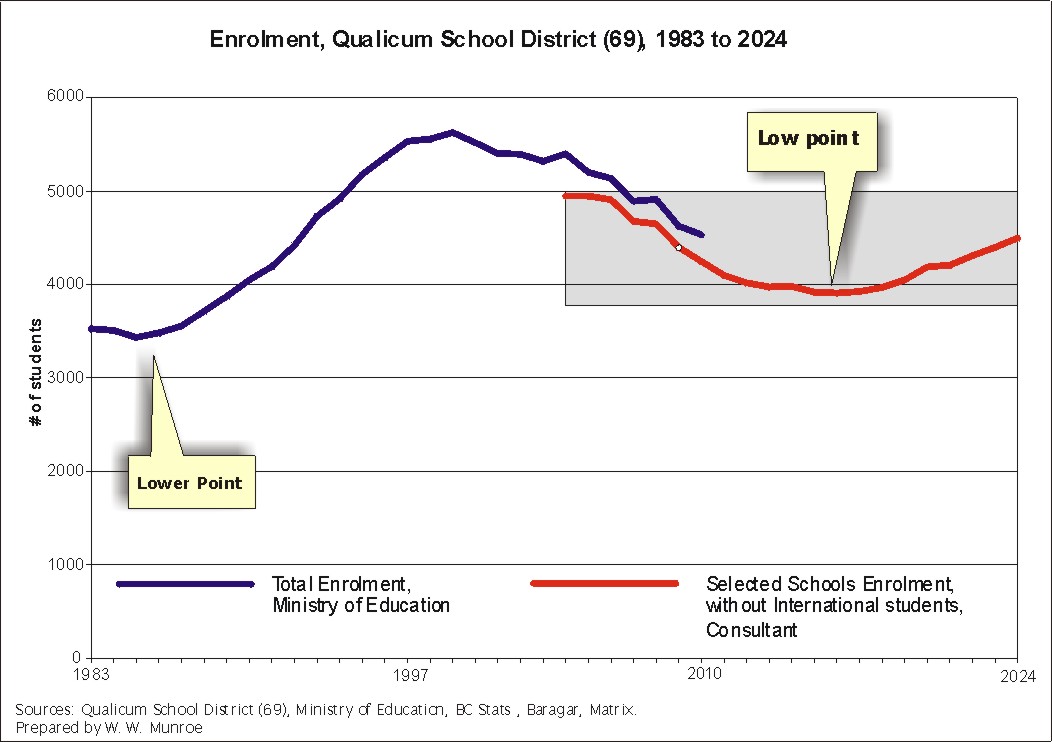
Chart used to justify recommendation to close the only Secondary School is incorporated (grey portion) in chart that includes enrolment since 1983 and also includes 3,800 students removed from the Qualicum School District chart (below). Read more...
Full information requests,
December, 2010
Correspondence with Ron Cantelon, MLA for Parksville/Qualicum requesting assistance with access to historical enrolment numbers
BC Stats' Real Methods Need to be Investigated,
October 7, 2010.
Response to Royal Society in London "Call for Evidence" regarding population modeling methodologies and the differences between Statistics Canada and BC Stats. Curiously, Gordon Campbell suddenly resigns.
Enrolment numbers tailored to justify school closure,
October 2, 2010
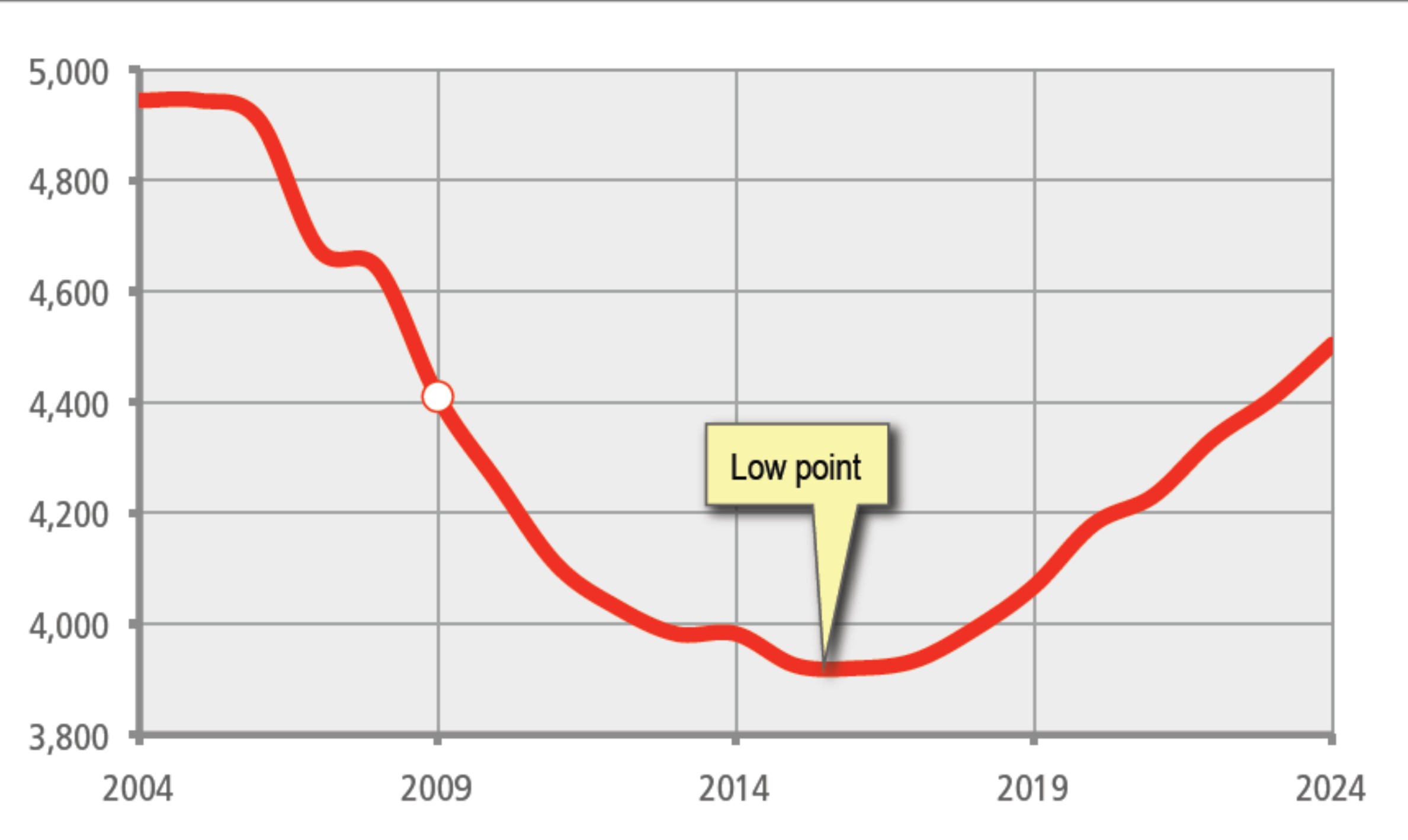
Chart used to justify recommendation to close the only Secondary School in Qualicum Beach presented October 2, 2010, also printed on the front page of a local newspaper, as well as shown on Vancouver Island TV News. Notice that the y-axis starts at 3,800, effectively removing 3,800 students from the chart. Also, the chart shows enrolment from 2004 to 2024. At the October 2 presentation I requested enrolment data prior to 2004 however, this was slow in coming and the closure was to be voted on in December 2010, so I asked the MLA Ron Cantelon to assist.
This chart was not labelled in the original report from the consultant, presented October 2, 2010, and incorrectly labelled in the final report. See the summary of the public presentation in January 2011 correcting this impression.
Statistical Agencies Analytical Activities,
September 2010
Advice refused to be disclosed by a head of a public body, regarding email referring to former Statistics Canada's Chief Statistician, Ivan Fellegie's, description of Analytical Activities at Statistics Canada.
Advice to BC Stats Executive Director Immediately Prior to Dismissal of Population Analyst Not Disclosed,
September 27, 2010
Letter to Freedom of Information Commissioner, regarding refusal to disclose advice from Michelle Charbonneau (PSA) to Don McRae, Executive Director of BC Stats, given one day prior to my dismissal from pubic service.
New Evidence Proves BC Provincial Government Efforts to Discriminate
September 13, 2010
Letter to BC Ministers of Labour and of Citizens' Services...Freedom of Information package highlights
1) the BCPSA reasoning for not allowing discrimination / human rights grievance to proceed is unjustifiable,
2) testimonies were documented and used against Population Analyst of which the Population Analyst was not aware; therefore, the Population Analyst was not able to offer any defence,
3) and the BCPSA was aware the Population Analyst was pursuing a grievance when he was dismissed.
Racial Profiling by BC Stats' Population Manager Regarding Statistics Canada Long Form,
July 22, 2010
Letter to Tony Clement, Federal Minister of Industry regarding BC Stats' Population Section Manager's racial profiling and racial slurs in discussions of analysis of Statistics Canada's 20% sample (long form).
Reference to Human Rights Violations by Population Analyst Used to Deny Arbitration into Real Matters in Dispute,
June 30, 2010
Letter to BC Ministers of Labour and of Citizens' Services regarding the duplicitous ruling used to cover up human rights, public service, and labour code violations
Freedom of Information Discloses Altered Statements by BC Stats' Executive Director,
May 14, 2010
Email to BC Ministers of Labour and of Citizens' Services regarding information contained in package from Freedom of Information
What BC Stats did for ElectionsBC for $50,000,
April 23, 2010
Letter to BC Ministers of Labour and of Citizens' Services highlighting Public Matters regarding ElectionsBC contract.
ElectionsBC is not interested in Quality of Population Projections,
April 16, 2010
Reply from ElectionsBC expressing no interest in quality of work done by BCStats.
Description of Human Rights Violations Used by BCPSA to Deny Arbitration into Real Matters in Dispute,
April 9, 2010
Letter to BC Ministers of Labour and of Citizens' Services regarding decision by Arbitrator to not allow arbitration for having raised Human Rights issues. The BCPSA lawyer proclaimed adamantly, "THIS IS NOT A HUMAN RIGHTS CASE!" The next reply from Ministers for Labour and CS and OG arrived via email, in response to my request for clarification of BC Stats real methods... go to November 2011. Read more...
Government Investigation Results Request,
March 24, 2010
Email to BC Ministers of Labour and of Citizens' Services requesting investigation report. Read more...
Freedom of Information Requests,
February 10, 2010
Requests for clarification made in December 2009 are still not answered Read request ...
BC Ministers responsibilities to research and evaluate problems,
February 1, 2010
Letter to BC Ministers of Labour and of Citizens' Services regarding responsibilities to research and evaluate problems.
Elections BC's $50,000 contract,
December 23, 2009
Description of how the Elections BC's $50,000 contract was done (referring to a map on the internet to guess the population for Electoral Districts in BC), and the consequences for developing a model using GIS.
The package from the FOI request reveals that the Executive Director of BC Stats, Don McRae, said I was not aggressive but rather intense. So that's why I was subjected to discrimination including dismissal ... because I was thought to be intense.
The Executive Director was the person who thought that using the change in telephone landline hookups, as an indicator of population change, was a good idea. Too bad the Executive Director didn't test that hypothesis as would be befitting of an Official Statistical Agency. Instead he chose to use the Population Analyst (me), who was providing solutions to the many problems, as a scape goat - to take the blame for his, Don McRae's, lack of quality. Bizarre.
Government Claims Records Made by Stenographer at Hearing Used to Deny Arbitration were Never Made,
November 30, 2009
BC Government falsely claims "there was no recording made of the meeting [preliminary hearing where the arbitrator decided not to allow arbitration to proceed] and therefore no transcripts." Read more ...
Request for a fair hearing into the real matters in dispute, as soon as possible,
November 25, 2009
Email to BC Ministers of Labour and of Citizens' Services, with June 10, 2009 letter to BC Human Rights Tribunal and LRB attached...again.
Finally, the Freedom of Information Office replies to the March 21, 2009 request for access to personal files, August 27, 2009, including ...
October 2009
...the transcripts from the October 13th 2005 meeting with Carol Gore, the transcripts from the June 22, 2007 meeting with Vince Ready; and the book of documents from the BCPSA given to Vince Ready on June 22, 2007. Read the letter from FOI.
Ministers Can Investigate,
September 30, 2009
Hostilities increased when the Population Analyst's projects were successful including: estatsBC, Regional Index Online, Population Estimates Model, the Monthly Interprovincial Migration Estimates Model, the Liquids database for current events, etc.
These and other issues are explained in a letter to BC Ministers of Labour and of Citizens' Services requesting that arbitration, with regard to the real matters in dispute, be allowed to proceed, with a list of questions. Read more...
LRB replies pretending that the case is too old for them to be able to think about,
June 22, 2009.
Here again is another example of how the government doesn't work. The LRB pretended that the case ended in 2007; therefore, the Population Analyst did not have the right to a fair and timely hearing.
Read the letter from the LRB showing the laziness and lack of competence therein. Recall, the BCGEU representative, Jan O'Brian, was a vice-chair for the LRB prior to revolving positions. She also co-authored to Judd case, 2003, protecting the BCGEU. No wonder I was not allowed to take courses about the Master Agreement from both the BCPSA and the BCGEU. They do not want people to be informed, but rather ill informed and easily brutalized. Bizarre.
Discrimination in Contravention of the BC Human Rights,
June 10, 2009
My solutions which reduced errors in the BC Stats population estimates and forecasts were considered confrontational by the long time employees one of whom was given the manager position. Subsequently, I was accused of not being able to control my behaviour (what behaviour, I have yet to be told) which made a co-worker, revised in June 2007 to two female coworkers, fear for their safety.
My requests for mediation were denied and I was required to submit a grievance. While the grievance was before the Deputy Minister, I was subjected to a mock firing in another attempt to coerce, threaten, and intimidate me, because I filed a complaint, and was about to participate in proceedings covered by the Labour Code, in contravention of the Labour Code, Section 5 (1).
These and other issues are explained in a letter to the Labour Relations Board, and the BC Human Rights Tribunal, with facts and relevant acts proving violations of the Public Service Act, the Labour Code, and the Human Rights Code by the Ministry, the BCPSA, and the BCGEU. Read more...
For 3 1/2 years the BCPSA, and the BCGEU put me thru many ever changing hoops in an effort to not allow a fair hearing into the real matters in dispute, namely the use of substandard and non-statistical methods used to create Official Population Statistics, to June 2009.
A First for BC Government? Without A Submission and Without the $200 Fee, the LRB Reviews it's June 2008 Verdict and Decides Again Not to Allow Arbitration into the Real Matters in Dispute,
October 29, 2008
This adversarial process with no fundamental fairness took 3 and a half years, from the time the grievance began in March 2005 to this October 29, 2008 self interested (the LRB is overseen by the Ministry of Labour and Citizens' Services), self supporting (the MLCS and LRB claim they did everything right), decision, to not allow arbitration to proceed. Why would the Ministry not want a review of the use of substandard and non-statistical used to create Official Population Statistics?
For the next seven months between November 2008 and June 2009, I had to dedicate my time souly to learning the legal lingo in an effort to put forward my case. I made several intensive efforts contacting over one hundred lawyers in and outside of BC to represent me with only two replies by two private firms. In one phone call, I was told it would cost $50,000 and when I mentioned the issue of ancestry the lawyer said "good luck" and hung up.
The other lawyer, a kindly gentleman past retirement, suggested that I get out of working in population analysis and he would not be able to help me... but he did point me to the law library. Also, I did get some very helpful information from an advocacy group regarding the fact that I did not have to prove that I have a mental disorder to utilize the human rights procedure. During this time I read as much as I could find on the internet and in the law library in Nanaimo. This research, along with finding old emails and scanning in documents, helped me forward my case. I was able to find out that I do have a sound case and that I must prepare to ask the Supreme Court for a continuance, to allow arbitration to proceed.
I also found out that the Minister of Labour and Citizens' Services can also allow arbitration to proceed. Also, I could ask the lieutenant governor for a public inquiry. However, such an inquiry could possibly be closed to the public. After the ridiculous efforts made by the BCPSAgency contract lawyer to discredit me and the continued unfair representation by the BCGEU advocate and former LRB Vice Chair, I see that a public inquiry will be necessary to ensure verification of the real methods and models used to create official population statistics. See the revised Data Warning webpage ...
Minister of Labour and Citizens' Services resigns suddenly
June 23, 2008
In May, the Minister assured me that the LRB is independent (however, the MLCS appoints the LRB ) .
The day after the kangaroo court type hearing (telling, yelling ... what is it with these people?), the Minister resigned.
From an article titled "Bennett blasts 'abusive' Campbell" in the Vernon Morning Star - By Tom Fletcher - BC Local News - November 17, 2010
"In recent days [Kootenay East MLA Bill] Bennett made public comments criticizing Campbell's cabinet shuffle and his decision to stay on as premier until February. Wednesday he amplified those criticisms, saying cabinet ministers Carole Taylor, Olga Ilich and Christy Clark left because of Campbell's intimidating presence and intolerance of dissent.
The first time he got angry with me, I simply said as a backbencher in my first year, I thought the caucus retreat wasn't very effective," Bennett said. "And he got so angry with me that he got in my face. He was so angry he actually spit in my face. He's not a nice man."
Minister of Labour and Citizens' Services Labour Relations Board Ruling to leave block to arbitration in place
June 22, 2008
the LRB decides to not allow arbitration. See the Original Data Warning webpage ...
After having taken over 8 months to reply, the LRB representative sets a 15 day deadline to come up with substantive issues. As a long time lawyer said, "Something stinks about this case".
Request to LRB about time for decision,
January 2008 to June 2008
I was told there is no time limit February 2008. I sent requests to MLAs thru March 2008 ... A NDP Labour critic staffer called by phone and suggested that I contact the Minister. April 2008. May 2008, the Minister, Olga Ilich, replied saying she would not interfere with the LRB's decision.
BC Stats' Executive Director goes on CBC Radio Claiming Close Ties to Statistics Canada,
December 5, 2007
BC Stats' Executive Director, Don McRae describes to CBC listeners how BC is attractive to migrants, claiming that BC is "tolerant"; however, he does not explain how BC Stats is very different from Statistics Canada, both in terms of independence from outside influence and quality of work.
These and other issues are described in a letter to CBC, sent the day after the interview with Don McRae, describing the real methods; eg. telephone data with electrical; lowering numbers outside the model.
Read Mark Forsyth's question with reply , December 6, 2007.
Request Arbitration and Natural Justice sent to the LRB
October 19, 2007:
Statements made in request for arbitration.
"The quality of the work done by the Population Section is at the heart of this issue."
"For example, the use of the change in telephone land lines as an indicator of population
change was implemented without proper statistical testing (cell phones makes this indicator
suspect), as was the splitting of the municipalities into two groups. Also, the Provincial Electoral
District Population Estimates and Projections were created using non statistical methods.
Databases were unorganized and incorrectly labelled. The Ministry of Finance changed the
migration projection arbitrarily, lowering it 7,000 people below model projections. Since the
migration numbers were low for the lower mainland, (7,000 people missing and cell phone use) I
was ordered to take people out of Comox/Courtenay and other high growth areas (Kelowna) and
told to put them into Richmond and Burnaby (telephone hookups had dropped) and I refused."
Read more...
BCGEU is not interested in discussing discrimination
May 4, 2007
Jan O'Brian, former Vice Chair of the Labour Relations Board, had told me that I could trust her; however, she drops the case and does not address discrimination on grounds covered by human rights code. Read more...
BC Stats kicks out Outliers from full dataset in an effort to reduce error,
September, 2006.
BC Stats also kicks out Analysts who provide solutions to reduce error without kicking out outliers. Email link sent to family and friends and interested folks across Canada describing Don McRae's order to kick out outliers in an effort to reduce the error in the population estimation model (GES) Read more...
Ordered to Leave and Take Belongings
February 16 2006.
The day after being ordered to leave and take my belongings, Michelle Charbonneau, PSA:EX wrote I was asked to leave. This is not what happened. I was ordered to leave. Read the notes made by Michelle Charbonneau.
Ordered to Leave and Take Belongings
February 15 2006.
While my grievance requesting mediation to address the manager's (Dave O'Neil) accusation that I made a co-worker feel unsafe (filing a grievance was required by the Executive Director Don McRae for mediation), I was ordered to attend a population projection meeting with the manager and the co-worker.
At these meetings only me, my co-worker, and the manager who first made the accusation, would be in attendance. Given the seriousness of the accusation I requested a resolution / mediation to find out what made my co-worker feel unsafe and what I could do, but this was denied and I was required to attend.
Instead of mediation to address the accusation, the manager and the shop steward came in. I was ordered to close the window, leave the computer on, gather my belongings, turn in my security pass and vacate the building.
The day before I was ordered to gather my belongings, turn in my security pass and leave the building
February 14 2006.
Mediation I requested, to address accusations that I made co-workers feel unsafe, was denied by BC Statistics Executive Director, Don McRae, again.
Email I sent to Executive Director, Don McRae, including a copy of Ivan Fellegi's 1999 speech to the STATISTICAL COMMISSION and ECONOMIC COMMISSION FOR EUROPE CONFERENCE OF EUROPEAN STATISTICIANS
"Such [conceptual] work requires the active intellectual partnership of the statistical office. So the analytic activity by the statistical office can and should highlight issues which new information could help to illuminate."
Events Leading Up To Firing
Prior to February 15, 2006
Go to the Journal page for a look at the way BC Stats' numbers are created.
Website content, code, and design by William Warren Munroe. Copyright ©